Contracting companies today run several projects at once, with subcontractors, payment certificates, suppliers, site engineers’ custody funds, and costs that change every week, so conflicts are constant. When these details are managed through Excel files and WhatsApp messages, problems surface quickly: schedule delays, budget overruns, and no clear view of the real profit on each project. This is where a contracting company system, one that brings all these operations together in one place, becomes essential.
What You Need in a Contracting Company System
Before choosing any system, define the functions a contracting company cannot do without. The most important things a contracting company system should provide:
- Linking each project to a budget and actual cost: to see the gap between planned and executed work in real time.
- Managing payment certificates and installments: tracking what has been paid and what hasn’t yet.
- Dealing with subcontractors: from contracting through settlement, including comparing bids and certificates.
- Purchasing and warehouses: to control material requests and deliveries to different sites.
- Quality control: inspection forms, recording of observations, and corrective actions.
- Custody and expenses: to control what engineers receive and what is spent on site.
- Clear management reports: showing profitability, progress, and delays without collecting data manually.
- Permissions and approval workflows: so nothing is paid or signed without the responsible person’s approval.
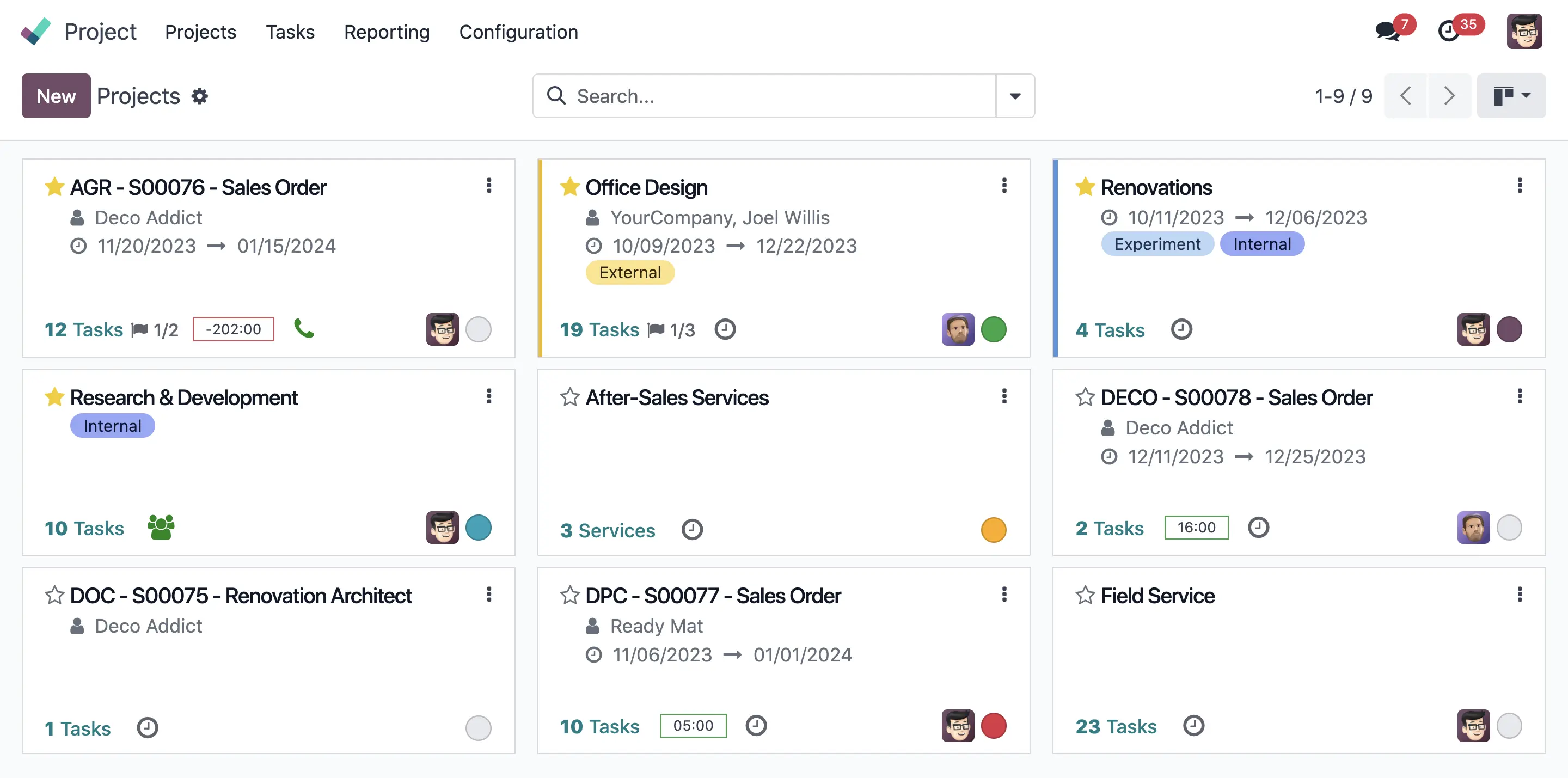
Odoo as a Contracting Company System
With Odoo, a platform known for its flexibility, you can activate only the apps you need and add others later. This makes it a suitable contracting company system, because contracting operations overlap with accounting, purchasing, warehouses, and projects all at once.
The most commonly used apps in contracting companies:
- Project: Break a project into phases and tasks, and link them to owners, deadlines, and working hours.
- Accounting: invoices, payments, and analytic accounts to know each project’s cost and revenue.
- Purchase and Inventory: purchase requests, purchase orders, and material movement between warehouses and sites.
- Expenses: record engineers’ expenses, then review and approve them.
- Quality: control points and inspections that can be tied to receiving and execution operations.
- Approvals and Documents: approval workflows, plus storage of contracts, drawings, and correspondence.
Managing Payment Certificates in Odoo
The payment certificate is the lifeblood of cash flow in contracting companies, and any delay or error in it hits liquidity directly. When you manage certificates inside a system instead of scattered files, you benefit from:
- Linking each certificate to the work items and quantities agreed in the contract, with completion percentages for each item.
- Automatically calculating deductions and retentions, such as the advance payment, performance retention, and taxes.
- Tracking the status of each certificate: under review, approved, issued as an invoice, paid.
- Seeing the remaining contract value at any time and knowing the amounts due from the client.
Odoo provides a strong foundation for progress billing, advance payments, and analytic accounting. If your company needs a certificate template that matches your current format in detail, it can be built with simple customization on top of these foundations.
Subcontractors and Comparing Certificates
A large part of project execution depends on subcontractors, and with them follow-up gets harder. The system helps you:
- Compare subcontractor bids before contracting in terms of price, duration, and terms.
- Record each contractor’s contract, its items, its value, and its payment terms.
- Compare the subcontractor’s certificate against what was actually completed on site and what the contract states, to catch any inflated quantities or unjustified items before payment.
- Track what has been paid to each contractor and what remains, and link that to the project’s cost.
This way, reviewing certificates moves from a process based on memory and estimation to a documented, numbers-based comparison.
Quality and Inspection Management in a Contracting Company System
Quality problems discovered late mean rework, extra cost, and delayed handover. That’s why any contracting company system needs a clear quality framework, and in Odoo you can:
- Define fixed inspection points for materials on receipt and for key execution stages.
- Record each inspection result (accepted or rejected) with photos and notes.
- Open a corrective action, assign an owner, and follow it through to closure.
- Keep a documented record to refer back to at handover or in any dispute with the client or a contractor.
Managing Engineers’ Custody
Site engineers receive cash, tools, and equipment, and failing to track them precisely leads to discrepancies that are hard to explain. Through the system you can:
- Record each engineer’s cash custody and link it to the relevant project.
- Enter expenses with attachments (invoices and photos), then review and approve them through a clear approval workflow.
- Settle the custody by comparing what was handed over, what was spent, and what remains.
- Record in-kind custody such as equipment and tools, including who received them and when they are to be returned.
The result: documented expenses, faster settlement, and correct cost allocation to each project.
Project Reports and Performance Measurement
What can’t be measured can’t be improved. The most important reports a contracting company’s management gets from the system:
- Profitability report per project: revenue against actual costs.
- Planned vs. executed comparison: in cost and in completion percentage.
- Certificate and receivables status: what has been collected and what is still outstanding.
- Subcontractor performance: adherence to deadlines, quality, and cost.
- Projected cash flow: to plan payments and purchases ahead of time.
- Dashboards showing key indicators to management without manual compilation.
Why Isn’t Excel Enough to Run a Contracting Company?
Many contractors start with Excel spreadsheets because they are quick and simple, but they lose effectiveness as the company grows and projects multiply:
- Duplicate data across multiple files and different versions of the same number.
- No permissions and no clear log of who changed what and when.
- No automatic link between purchasing, warehouses, and accounting.
- Reports are compiled manually and arrive late, so decisions are made on outdated figures.
An integrated system, by contrast, lets data be entered once and appear everywhere it’s needed.
Frequently Asked Questions About Contracting Company Systems
What is a contracting company system?
It is an electronic system that brings together project management, payment certificates, purchasing, warehouses, quality, custody, and accounting on one platform, instead of spreading them across separate files and programs.
Is Odoo suitable for small and medium contracting companies?
Yes, because Odoo lets you start with a limited set of apps and expand gradually as the company grows, without a huge upfront cost.
Can I manage payment certificates and subcontractors on Odoo?
Odoo supports progress billing, analytic accounting, purchase orders, and contracts, and it can be customized to match your company’s certificate format and approved bill-of-quantities structure.
Can the system be used on mobile?
Yes, Odoo is available through the browser and a mobile app, which makes it easy for engineers to record expenses and observations directly from the site.
How long does it take to implement the system in a contracting company?
It varies with the company’s size, the number of apps required, and the amount of customization. You can start with the essentials in a short time, then add the remaining functions in phases.
What is the difference between Odoo and traditional contracting software?
Odoo is an integrated ERP system that links contracting with accounting, purchasing, inventory, and human resources, whereas many traditional programs focus on a single aspect, so you have to link them manually to the other departments.
Conclusion
Choosing the right contracting company system is a decision that directly affects profitability, liquidity, and the speed of decision-making. With its interconnected apps and flexible customization, Odoo gives you a strong foundation for managing payment certificates, subcontractors, quality, custody, and reports on one platform. Start by defining your needs, pilot on one project, then expand usage gradually.
Request a consultation from Centione, Odoo’s Gold Partner in Egypt, to determine the right path for managing your company.